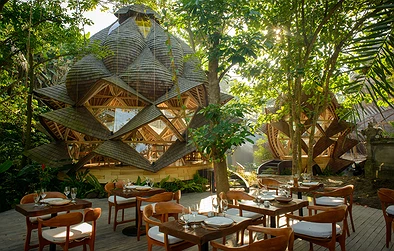

There are places you visit and places that visit you back. Aura House, a hand-shaped bamboo structure curling along the edge of Bali's Ayung River gorge, belongs firmly in the second category. It was designed by IBUKU, the architecture collective founded by Elora Hardy - daughter of Canadian jewelry entrepreneur and environmental pioneer John Hardy - and it looks less like something built and more like something that simply arrived, fully formed, from the forest floor. Three stories. 130 m² (1,400 sq ft) total. Every inch of it bamboo.
Location

Aura House sits within Green Village, a sustainability-focused residential and hospitality community on the southern outskirts of Ubud, near Sibang. It's about 30 minutes by road from Ubud's center, and within walking distance of Green School, the internationally recognized bamboo campus that the Hardy family also founded.
The immediate setting is a steep river valley - the Ayung gorge - dense with jungle and loud with the kind of quiet that only moving water creates. You are not in a resort. You are not in a hotel. You are on a ridge, above a river, inside a forest.
From Jewelry To Jungle Architecture

Green Village began as an extension of the Hardy family's long commitment to sustainable living on the island, where John Hardy has been based since the 1970s. His daughter Elora founded IBUKU in 2010, after returning to Bali and beginning to seriously explore bamboo as a structural and architectural material rather than a decorative one.
Aura House was the last of three small villas built along what the team called "the ridge" at Green Village - three siblings, similar in structure and design philosophy, but each distinct in construction and material detail.

The project was completed in 2018, engineered by Ashar Saputra, and designed with affordability in mind - relative to IBUKU's broader portfolio - without compromising the studio's signature aesthetic. It was conceived as a development house: a way to offer a genuine bamboo living experience to travelers, while proving that sustainable construction could be both beautiful and financially accessible.
Bamboo Architecture

The material is Dendrocalamus asper, a species of bamboo grown locally in Bali. It's not a decorative choice. Asper is structurally serious: dense, flexible, and strong enough to carry the full load of a three-story building cantilevered over a river gorge.
The structural typology is post and beam, with bamboo columns springing up from a small number of foundation points and launching forward into the valley - a deliberately light footprint on a steep and ecologically sensitive site.

Yoga shala
What IBUKU does with bamboo goes well beyond standard construction practice. The studio treats it as a craft material: the joints are lashed, the forms are curved, the balustrades curl like plant tendrils. Inside Aura House, every fixture - light fittings, kitchen cabinets, stair rails - was handcrafted by local Balinese artisans.

The building rises 15 m (49 ft) and reads differently depending on where you're standing. From below, it looks like a canoe or a seashell - curves inside curves. From within, the woven walls filter light in a way that shifts constantly through the day, the way light behaves in a forest rather than in a room.
The Stay

The 130 m² (1,400 sq ft) are divided across three levels, each with its own character. The two bedrooms occupy the lower levels, each with its own en-suite bathroom and air conditioning. One is nestled into the earth, walled in stone with a curved bamboo-screened entrance - cooler, quieter, slightly cave-like in the best possible way.

The other is a leaf-shaped room with bamboo floors, walls, and ceiling, more open, more aerial. Between the two, an acoustic insulation layer sits inside the ceiling-floor cavity to keep sound from traveling between the rooms.

Every level has a terrace. One is sized for breakfast, another for yoga or hammock time. There are outdoor showers on the terraces, which turn a routine activity into something you'll mention later. The private pool is small and positioned to face the gorge - less lap pool, more perch - and it functions exactly as intended, which is to give you somewhere to float while looking at the forest.

Aura House offers room service and the option of having meals prepared and delivered to whichever terrace you've claimed for the afternoon. The menu skews Balinese, with enough international range to cover most preferences.

On the Balinese side, the standout is the Nasi Campur - brown rice served with Ayam Betutu (smoked chicken in traditional spices), Sate Lilit Ayam (minced chicken on a skewer), Lawar (chopped vegetables with Balinese spice), and Tempe Manis (sweet fermented soybean).
It's a full expression of the local table, and the kind of thing that tastes significantly better eaten outdoors above a river than it does in a restaurant. For dinner, the Special Balinese Jaen - a more elaborate version of the same tradition - requires 24 hours advance notice and ends with Klepon, Balinese sticky rice balls filled with palm sugar.

The breakfast included on your first morning runs from Nasi Goreng to omelettes to pancakes, all served with fresh fruit. After that, the full menu is available, and the terraces are patient enough to accommodate whichever meal takes longest.
Sibang Gede, Abiansemal, Badung Regency, Bali 80352, Indonesia