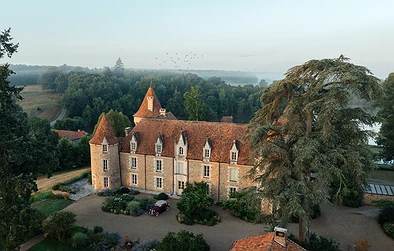

There's a giant gorilla watching over the grounds. A wolf, frozen mid-sprint, tears through the woodland. And somewhere above the kitchen garden, suspended nearly 28 meters (92 feet) off the ground in a pod that looks like it belongs in a 1970s science fiction paperback, someone is waking up to a view of the French countryside while technically sleeping inside a tree.
The Domaine du Château des Pères sits just south of Rennes - 25 minutes by car, a world away in atmosphere - and it has been quietly reinventing itself, since the Legendre family acquired it in 2011, into one of Brittany's most eccentric and genuinely brilliant destinations.
A 12th-century estate with a Michelin-starred restaurant, a free sculpture park, a meal served by pulley six meters up in an oak tree, a spa, a cocktail bar inside a restored greenhouse, and a family buffet in a former pigsty. These things coexist here without any of them feeling like an afterthought.
The estate has been in the hands of the Legendre family since 2011. Jean-Paul Legendre - who grew up nearby - bought it with the specific ambition of turning it into somewhere art, craftsmanship, and hospitality could live together without any of them feeling like an afterthought. His son Julien now runs the day-to-day operation. Between them, they've created something that defies easy categorization, which is probably the point.
The Long, Turbulent Life of a Breton Estate

Château des Pères & L'EssenCiel Hotel
The site began in the 12th century as a feudal motte - a fortified mound ringed with sharpened wooden stakes called "plesses," which gave the original estate its name. In 1432, the first proper stone château was burned to the ground, allegedly by English forces during the Hundred Years' War. It was rebuilt.
It was seized during the French Revolution and sold at auction for 16,040 francs after the Marquis de Rosnyvinen - reputedly quite the character - died at 84 still resisting. It was returned to the family, fell into severe decay, and was slowly restored again.

The family who owned it longest, the Rosnyvinens, left behind a coat of arms featuring a boar's head and a motto that suits the place perfectly: "I attack only when wounded." Their battle cry was "Defend yourself." Their timeless maxim: "In all paths, integrity."
At their peak, the estate encompassed nearly 300 properties - manors, farms, mills. The park is believed to have been designed in the 17th century by André Le Nôtre, the landscape architect behind Versailles.

The final twist came in 1923, when the Congregation of the Holy Ghost Fathers acquired it and ran it as a training center and later a retirement home for clergy - which is where the current name comes from. The Castle of the Fathers.
When Jean-Paul Legendre bought it in 2011, he inherited a place with extraordinary bones and a slightly complicated identity. What he built from it is what you find today.
The Sculpture Park

The park is the heart of everything here, and the fact that it is entirely free and open to the public without reservation (unless you arrive in a group of more than 15) feels almost countercultural in an era when every cultural experience seems to require advance booking and a membership card.
There are no gates to pass through. You simply walk in and follow the 3-kilometer (roughly 2-mile) trail through 31 hectares of meadows and woodland, encountering monumental figurative sculptures that appear without warning between the trees or across an open field.
Works by 31 artists are currently displayed throughout the estate. Among them are established names in contemporary sculpture: Michel Audiard, Francis Guerrier, Christophe Charbonnel, Violaine Dejoie-Robin, Nicolas Lavarenne, Davide Rivalta, and Sophie Verger, among others.

The collection is not static. Each year, the park hosts a solo exhibition by an internationally recognized sculptor - several of whom have had works acquired for the permanent collection after their show.
In 2026, the featured artist is Emmanuel Michel, a traveling sculptor whose works on display through October draw from his encounters in remote parts of the world. A companion exhibition of his drawings, paintings, and engravings is on display in the Gallery-Store at the château entrance.
The Château

The building at the center of the estate - the east-west wing of which dates back, in part, to the medieval original - has been carefully restored and serves as the venue for events, receptions, and weddings. The Legendre family's stated ethos is the celebration of craftsmanship and "manual talent," and the restoration reflects that: the work was done by skilled artisans, and the results show it.
The château also contains the Gallery-Store, the estate's primary welcome point, where you can get information about current exhibitions and pick up works connected to the on-site artists. Five artists have permanent studios on the estate and offer workshops in carving, modeling, linocut, paper sculpture, and other techniques throughout the year - open to beginners as well as those with more experience.
The Greenhouse - La Serre

The estate's former greenhouse, fully restored, now operates as a cocktail bar under the direction of the team at La Table des Pères. The concept is seasonal and ingredient-forward: the mixologists draw from the kitchen garden right outside to create drinks that change as the year progresses - elderflower in spring, aromatic herbs through summer, and so on.
Classic cocktails are reworked with flowers and foraged botanicals; entirely original creations sit alongside them on a menu that treats the glass as a kind of ephemeral artwork.

La Serre operates in two distinct modes. For those staying at the hotel or dining at La Table des Pères, there's a pre-dinner aperitif experience: a cocktail of your choice, accompanied by gourmet canapés prepared by the restaurant kitchen. This is available on Wednesday through Saturday evenings and Sunday lunchtime.
For everyone else, the bar also welcomes walk-in reservations on Wednesdays through Saturdays for à la carte cocktails - without the canapés, but with the full seasonal menu and the pleasure of sitting inside a beautifully restored glass structure in the middle of a working kitchen garden.
La Table des Pères

The restaurant that put the estate on the culinary map opened in 2015 and earned a Michelin star in 2023. It sits within a rotunda structure near the hotel, with panoramic views across the kitchen garden that is also its primary source of inspiration.

Chef Jérôme Jouadé's cooking is rooted - literally - in what grows a few steps from the kitchen. Wild foraged ingredients, fruit trees, aromatic herbs, mushrooms, and edible flowers all feed directly into dishes that change with the seasons. His stated philosophy involves a long list of adjectives - flavorful, bold, playful, elegant, informative - but what it amounts to in practice is cooking that takes its garden very seriously while refusing to be solemn about it.

The menu runs to either five or eight courses. A children's menu is available for those under 12. Pairing options for both wine and non-alcoholic alternatives are offered alongside the food menus.
Le Re-Père

Le Re-Père is the estate's family restaurant, and it operates on an entirely different register from the Michelin-starred neighbor up the path. It occupies the estate's former pigsty - a detail the designers leaned into rather than obscured.

Exposed beams, old stone walls, and a general feeling of comfortable rusticity make it one of those rooms that improves in direct proportion to the noise level around the table.
The food is an all-you-can-eat buffet built around the kind of cooking that French grandmothers are theoretically responsible for and that urban restaurants have been attempting to recreate, with varying success, for decades. Meats roasted on a rotisserie. Potato gratin. Apple tart. Classic recipes updated without being overthought. The sourcing leans local and seasonal throughout.
La Guinguette du Re-Père

When the weather cooperates - which in Brittany requires something approaching optimism - the terrace behind Le Re-Père opens as an outdoor bar. A guinguette is a specifically French concept: an informal riverside or garden tavern associated with music, dancing, and the particular kind of uncomplicated pleasure that arrives on the first genuinely warm afternoon of the year.
The Guinguette du Re-Père captures some of that spirit without the riverside. There are wooden tables, a shade sail, fairy lights for the evenings, and a bar serving craft Breton beer on tap, a house mojito, wines, cocktails, and hot drinks.
Homemade ice cream is available daily; cookies appear on weekends. Yard games - Breton shuffleboard, Mölkky, pétanque - are set up across the terrace. Live outdoor concerts take place through the summer.
Hotel L'EssenCiel: The Architecture

There are hotels that make a statement and hotels that genuinely ask questions. L'EssenCiel, which opened in 2023, falls firmly into the second category. The building was conceived by Jean-Paul Legendre and designed by architect Anthony Rio of Agence Unité, based in Nantes. The concept is patented and - the estate is not shy about saying this - unique in France.
The building is modeled on the structure of a tree. A central concrete trunk rises 28 meters (92 feet) from the ground; branches extend outward from it, and from each branch hangs a suspended pod - a "bubble" or "cocoon" - that functions as a hotel room.
The exterior profile is unmistakably retro-futuristic, in the best possible tradition of 1970s and 1980s European experimental architecture. Rio himself has noted that different visitors will see different things: the bubble buildings of the 1980s, a Calvino novel, or something more universal - the childhood fantasy of a treehouse suspended between earth and sky.

Construction began in 2019 and involved some genuinely complex engineering: 80 cubic meters of concrete poured at height, 16 tonnes of steel installed on the dome using a 50-meter (164-foot) crane, rooms lifted into position and bolted to cantilevered walkways.
The interior design was handled by Wunder Architectes, who made the intelligent decision not to compete with the exterior. The rooms are deliberately quiet - a vocabulary of natural colors drawn from the sky at different times of day, custom wood furniture, restrained decoration.

The hotel has 42 rooms, each 26 square meters (280 square feet). Thirty-six of these are perched on the branches of the tree structure, at varying heights. The highest rooms sit at over 28 meters (92 feet) above ground. Six rooms are at ground level for those who'd prefer not to test their relationship with heights; three of these are fully adapted for guests with reduced mobility.
Every room is styled to the same minimalist brief - the point is not the decor but the view through the oculus, which changes depending on your elevation and orientation.

Each room's large circular oculus window frames the landscape like a porthole - the countryside, the château, the sculpture park - depending on where in the tree you happen to be perched.
The Spa

On the ground floor of the hotel building, a 300-square-meter (3,230-square-foot) spa offers the full range: indoor pool with hydrotherapy, sauna, hammam, relaxation areas, and two treatment rooms. The skincare and treatment philosophy is built around CODAGE, a French bespoke skincare brand whose approach involves personalized formulations rather than off-the-shelf routines.
The spa is open to both hotel guests and visitors to the estate, making it a standalone option for those who want to combine a visit to the sculpture park with something more restorative.

The spa's indoor pool - looking out into the estate's landscape - makes it feel less like a basement wellness facility and more like a continuation of the same relationship with nature and light that defines the hotel above it.
Le, Château de Piré, 5000 Le Chateau de Piré, 35150 Piré-Chancé, France